
$64,000 Question (2000)
ABC Carnival '74
Across the Board
Baloney
Bamboozle
Be What You Want
Beat The Genius
Beat The Odds (1962)
Beat The Odds (1975)
Bedtime Stories
Big Spenders
Blank Check
Body Language
Body Talk
Bullseye
Call My Bluff
Card Sharks (1996)
Casino
Caught in the Act
Celebrity Billiards
Celebrity Doubletalk
Celebrity Secrets
Celebrity Sweepstakes
Chain Letter (1964)
The Challengers (1974)
Change Partners
Child's Play
Combination Lock (1996)
Comedy Club
Concentration (1985)
The Confidence Game
Cop Out
Countdown (1974)
Countdown (1990)
Crossword
Decisions, Decisions
Dollar a Second
Duel in the Daytime
Fast Friends
$50,000 a Minute
Finish Line (1975)
Finish Line (1990)
Get Rich Quick
Going, Going, Gone!
Head of the Class
High Rollers
Hollywood Squares (1965)
Hollywood Squares (1985)
Hot Numbers
Hot Potato
House to House
How Do You Like Your Eggs?
Jackpot (1984)
Jeopardy (1977)
Jokers Wild
Jumble
Key Witness
Keynotes (1986)
King of the Hill
Let's Make a Deal (1963)
Let's Make a Deal (1990)
M'ama Non M'ama
Match Game (1962)
Match Game (1973)
Match Game (1990)
Match Game (1996)
MatchGame (2008)
Mindreaders
Missing Links
Monday Night QB
Money in the Blank
Money Words
Moneymaze
Monopoly (1987)
Nothing But the Truth
Now You See It (1986)
Oddball
100%
PDQ
Party Line
People On TV
Play For Keeps
Play Your Hunch
Pot O' Gold
Pressure Point
Pyramid (1996)
Pyramid (1997)
A Question of Scruples
Quick as a Flash
Razzle Dazzle
Riddlers
Run For The Money
Says Who?
Scrabble (1990)
Second Guessers
Second Honeymoon
Sharaize
Shoot for the Stars
Shoot the Works
Shopping Spree
Show Me
Showoffs
Simon Says
Smart Alecks
Smart Money
Spellbinders
Spin-Off
Split Decision
Star Cluster
Star Play
Strictly Confidential
TKO
Talking Pictures (1968)
Talking Pictures (1976)
Tell It to Groucho
Temptation (1981)
$10,000 Sweep
The Better Sex
The Big Money
The Big Payoff
The Buck Stops Here
The Choice Is Yours
The Couples Race
The Fashion Show
The Honeymoon Game
The Love Experts
The Plot Thickens
The Price Is Right (1972)
The Waiting Game
Three of a Kind
Tic Tac Dough
Tie-Up
Top Secret
Twenty One (1982)
Twenty Questions
Twisters
Up and Over
We've Got Your Number
What Do You Want?
What's On Your Mind
Wheel of Fortune
Whew!
Whodunit
Whose Baby
Wipeout
Word Grabbers
Write Your Own Ticket
You Bet Your Life (1988)
You Bet Your Life (1991)
You're Putting Me On
Show a Random Pilot
Show Unreviewed Pilots
Bob Stewart Flow Chart
Now You See It (1985)
Producer: Mark Goodson
Host: Jack Clark
Announcer: Gene Wood
Taping Info: November 17, 1985
Made it to Air: No, although different versions aired both before (April 1, 1974-June 13, 1975) and after (April 3-July 14, 1989).
Availability: It's on the trading circuit, however, copies are pretty poor.
In 1985, Mark Goodson was trying to do again what he had done 13 years earlier, take some medium-level shows from the past and jazz them up for a new time. This formula worked with The Price is Right and Match Game, so Goodson first tried changing Concentration to a linking rather than a matching game (it didn't work) and now was off to change Now You See It (and it didn't work either). Jack Clark made a rare non-70s foray from behind the mike and onto the screen to be the host of this syndicated effort.
As we all know, Now You See It is a game of definitions. Actually, no it wasn't, but this version tried. The first round consisted of two teams of two contestants who would alternate giving a definition of a word to their partner. Their partner would then have 15 seconds to try to find the word in a 4x15 grid and tell its row number and the word itself. The team is then awarded the number of seconds remaining on the clock. Each team plays four word combos and the team ahead at the end of this round is awarded a 20 point bonus and scores carried to the second round. Players did not alternate roles in this round — players were either the definition giver or word finder for all three words.
The second and third rounds would be considered "Classic Now You See It". Jack Clark would read a definition, and the player who was the definition giver in Round 1 would buzz in and give row number of the word plus the word itself. 20 points per word were given for a correct location, with 100 points. Due to the points grabbed in the first round, this round basically was the Round 1 winner needed to find 3 words while the Round 2 winner needed to find 4. The winning team then had one of the players go over to the bonus game.
The bonus game played exactly like the 70s version down to the single-handed clock. You had 60 seconds to find 10 words and circling them on the 4x15 grid. Win or lose, the teams returned for the second half with their roles reversed, definition givers became word finders and vice-versa. Winnings for the game were "Pyramidal", you won $5,000 if you won the bonus game, but you tried for $10,000 if you went for the bonus twice on the same show. Non-winning bonus rounds were $100 per word.
It just wasn't the same with the definitions. It slowed down what seemed like what was a fast-paced game. On a positive note, it continued to use "Chump Change" by Quincy Jones as its theme, probably the best ever game show theme not written specifically for a game show. If only this letter-based word game had been on the air longer, its theme could have been a popular culture icon, and it maybe could have been used in a movie about a wacky time-traveling spy. Oh what could have been.
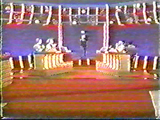 The set, which moved around depending on which round it was. |
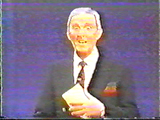 Host Jack Clark |
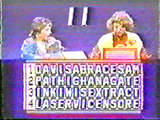 A snapshot from Round 1, the definition giver is on the left, the word finder on the right. |
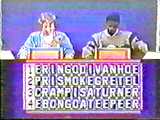 A snapshot from Round 2. |
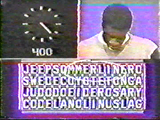 From the bonus game, notice that except for the computerized letter board, this could be from the 70s version. |
This pilot has been viewed 15401 times since October 6, 2008 and was last modified on Dec 12, 2009 14:46 ET
Feedback? Contact me at usgs-pilot at the usgameshows dot net domain