
$64,000 Question (2000)
ABC Carnival '74
Across the Board
Baloney
Bamboozle
Be What You Want
Beat The Genius
Beat The Odds (1962)
Beat The Odds (1975)
Bedtime Stories
Big Spenders
Blank Check
Body Language
Body Talk
Bullseye
Call My Bluff
Card Sharks (1996)
Casino
Caught in the Act
Celebrity Billiards
Celebrity Doubletalk
Celebrity Secrets
Celebrity Sweepstakes
Chain Letter (1964)
The Challengers (1974)
Change Partners
Child's Play
Combination Lock (1996)
Comedy Club
Concentration (1985)
The Confidence Game
Cop Out
Countdown (1974)
Countdown (1990)
Crossword
Decisions, Decisions
Dollar a Second
Duel in the Daytime
Fast Friends
$50,000 a Minute
Finish Line (1975)
Finish Line (1990)
Get Rich Quick
Going, Going, Gone!
Head of the Class
High Rollers
Hollywood Squares (1965)
Hollywood Squares (1985)
Hot Numbers
Hot Potato
House to House
How Do You Like Your Eggs?
Jackpot (1984)
Jeopardy (1977)
Jokers Wild
Jumble
Key Witness
Keynotes (1986)
King of the Hill
Let's Make a Deal (1963)
Let's Make a Deal (1990)
M'ama Non M'ama
Match Game (1962)
Match Game (1973)
Match Game (1990)
Match Game (1996)
MatchGame (2008)
Mindreaders
Missing Links
Monday Night QB
Money in the Blank
Money Words
Moneymaze
Monopoly (1987)
Nothing But the Truth
Now You See It (1986)
Oddball
100%
PDQ
Party Line
People On TV
Play For Keeps
Play Your Hunch
Pot O' Gold
Pressure Point
Pyramid (1996)
Pyramid (1997)
A Question of Scruples
Quick as a Flash
Razzle Dazzle
Riddlers
Run For The Money
Says Who?
Scrabble (1990)
Second Guessers
Second Honeymoon
Sharaize
Shoot for the Stars
Shoot the Works
Shopping Spree
Show Me
Showoffs
Simon Says
Smart Alecks
Smart Money
Spellbinders
Spin-Off
Split Decision
Star Cluster
Star Play
Strictly Confidential
TKO
Talking Pictures (1968)
Talking Pictures (1976)
Tell It to Groucho
Temptation (1981)
$10,000 Sweep
The Better Sex
The Big Money
The Big Payoff
The Buck Stops Here
The Choice Is Yours
The Couples Race
The Fashion Show
The Honeymoon Game
The Love Experts
The Plot Thickens
The Price Is Right (1972)
The Waiting Game
Three of a Kind
Tic Tac Dough
Tie-Up
Top Secret
Twenty One (1982)
Twenty Questions
Twisters
Up and Over
We've Got Your Number
What Do You Want?
What's On Your Mind
Wheel of Fortune
Whew!
Whodunit
Whose Baby
Wipeout
Word Grabbers
Write Your Own Ticket
You Bet Your Life (1988)
You Bet Your Life (1991)
You're Putting Me On
Show a Random Pilot
Show Unreviewed Pilots
Bob Stewart Flow Chart
Twenty-One (1982)
Producer: Barry-Enright
Host: Jim Lange
Announcer: Charlie O'Donnell
Taping Info: April 24, 1982 at CBS Hollywood
Made it to Air: This version, no. It ran in prime-time from 1956-1958 plus a run in 2000.
Availability: Trading circuit
It was big in the 1950s. And, if it wasn't rigged, it would have been a very boring show. So, Barry-Enright, seeing that Bullseye is failing, tries to get a new show ready for syndication. Jim Lange, without glasses, is your host.
Same rules as before, there are questions whose values are chosen by the contestants, and they can be worth anywhere from one to eleven points, with one being easy and eleven being very hard. You receive the points if you answer the question correctly, or have them deducted if you answer incorrectly. The two contestants are in isolation booths, since there is the possibility that the players may get the same question if they pick the same point value, plus the strategy of not knowing when to hold them and when to fold them in respect to your score. The category of the question is determined randomly by a spin of Jim Lange's question Lazy Susan keeping him company while the contestants are in the isolation booths.
If you win the game, either by reaching an uncontested 21 or calling for the end of the game after any completed question round and having more points than your opponent, you win $1,000 per point difference in the scores. If the previous game had tied, the winnings was $2,000 per point difference. Unlike the 50's, there was a bonus game, a classic Barry-Enright no skill involved affair, where you essentially played Blackjack against the house. You decide whether the next draw will go to you or the computer, with the computer staying at 17 or up. If you win, you added $2,000 to your score and won a trip.
The kicker, like on the 50's show, was that a returning contestant had the chance to lose money. If a player decided on defending his/her championship, they would lose the money won by the other player in the game they eventually lost. For example, if you had $16,000 going into a game and lost by 7, your final total would be $9,000.
And of course, this was rigged too, since Jim forgot to ask whether to end a game after a round of questions and nobody seemed to mind. You can do that, because it's a pilot, but if you have to, what makes you think the game is going to work, especially five-a-week? Music for the pilot was provided by the Alan Parsons Project, which I believe is some form of hovercraft.
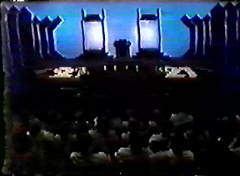 The new modern set of 21. |
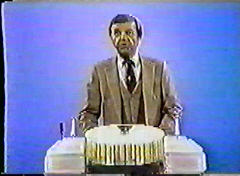 Your host, the unbespectapled Jim Lange. |
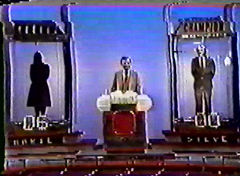 The contestants in their booths, no sweaty guy to be found anywhere. |
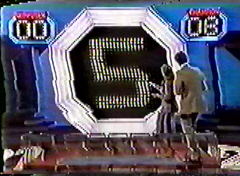 The bonus game, supposedly random, but you never know with a big computer just spouting out numbers. |
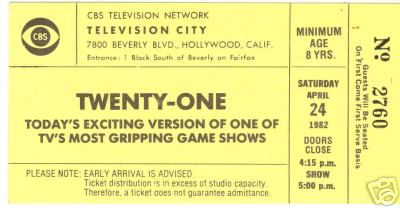 A ticket from the pilot. |
|
This pilot has been viewed 4385 times since October 6, 2008 and was last modified on Dec 12, 2009 14:46 ET
Feedback? Contact me at usgs-pilot at the usgameshows dot net domain